Listeners:
Top listeners:
-
 play_arrow
The Canadianist Radio Listen. Watch. Read. Discuss. We're in the middle of everything.
-
 play_arrow
Canadianism Podcast | S2 E7 | Quebec Is About to Show Canada What’s Wrong With Our Voting System
SUBSCRIBE NOW TO OUR MAILING LIST

When Did Concerts Get So Damn Perfect?
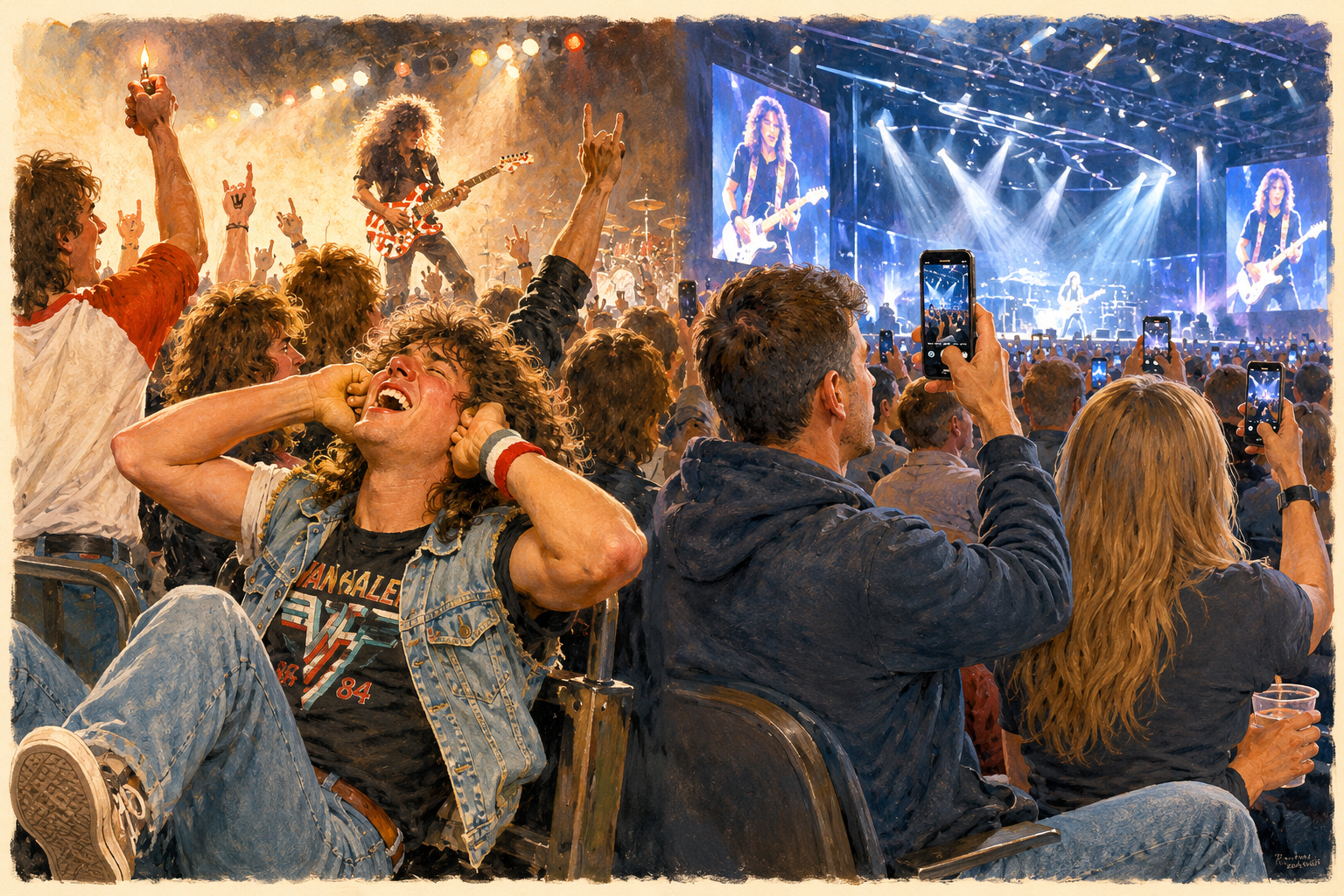
When Did Concerts Get So Damn Perfect?
The sound is better. The lights are better. The shows are safer. So why does it sometimes feel like we lost something along the way?
I’ve been watching clips of Rush’s current tour with Anika Nilles, and they sound great. Really great, actually. Considering we’re talking about musicians whose history stretches back more than 50 years, it’s remarkable. The playing is there, the production is spectacular, the sound is clear, and everything about the show appears to be executed at an extraordinarily high level.
And yet, watching it, I couldn’t shake the feeling that something was missing.
This isn’t really about Rush. Part of what I’m seeing there is obviously the atmosphere surrounding a band with that kind of history. There’s a reunion quality to it. People who grew up with Rush are there, but so are famous faces and people born years after the band’s heyday. Going to see one of these legendary acts has itself become something of an event. But I’ve noticed the same thing watching plenty of other modern concerts, including artists at the peak of their careers.
Somewhere along the way, concerts got awfully civilized. And I’m beginning to wonder whether, in fixing everything that used to be wrong with them, we accidentally fixed some of what was right.
April 19, 1984
I know exactly where I was on April 19, 1984. I was at the Montreal Forum watching Van Halen. So were what seemed like half the people I went to school with.
Van Halen had released 1984 only a few months earlier. “Jump” was enormous. “Panama” was coming. This wasn’t a band coming around 40 years later to remind us of what they had once been. This was Van Halen happening right fucking now, and the Forum was pandemonium.
There’s footage of that Montreal show on YouTube today, one of the very few surviving recordings from that tour. When I watch it now, I’m struck by how primitive parts of it seem compared with a major arena production today. The sound isn’t pristine. The performance isn’t surgically precise. The lighting certainly wasn’t being designed with thousands of smartphone cameras in mind.
And it was unbelievably loud. I remember putting my fingers in my ears because it was the only way I could properly make out what I was hearing. Obviously, that’s not something we should be nostalgic about from a health standpoint. If your ears are telling you to cover them, they’re trying to tell you something important. But here’s the strange part: I remember that physical sensation as part of the concert.
I remember trying to say something to the friend standing beside me and neither of us being able to understand the other. I remember the screaming, the roar of the room, the lights, the lighters, and the feeling that thousands of people and one very loud rock band were creating something that wasn’t entirely under anybody’s control.
It wasn’t polished. It was alive.
We Didn’t Have Selfies. We Had T-Shirts.
There’s an easy argument to make here about smartphones and social media ruining concerts, but I don’t entirely buy it. We weren’t somehow culturally superior in 1984 because we didn’t have Instagram. We wanted everyone to know we’d been there too. We just had the concert T-shirt.
The next morning at school, everyone walking through the halls wearing the Van Halen shirt knew exactly where everyone else wearing one had been the night before. You didn’t need a selfie. The shirt said it. It was almost a campaign ribbon: I was there. You were there. Holy shit, what a night.
So the desire to make attendance at a concert part of your identity isn’t new at all. What’s changed is when we do it. We had to wait until the next morning. During the concert itself, there wasn’t anyone else to show. There was no outside audience watching our experience, nobody at home waiting for the clip, and no feed to update. For those couple of hours, the only people who mattered were the people inside the Forum.
You had to finish being there before you could tell everyone you’d been there. I wonder whether that mattered more than we realized.
It Sounds Almost Too Good
The other thing I notice about modern arena shows is just how good they sound. The technology is extraordinary. Modern PA systems can deliver enormous power with remarkable clarity. Musicians have sophisticated in-ear monitoring. Digital consoles can recall incredibly detailed settings. Lighting, video and effects can all be synchronized. Click tracks and timecode can keep enormous productions running with incredible precision. And yes, backing tracks and prerecorded elements are part of some modern shows too.
I’m not suggesting everyone is secretly miming up there. Far from it. There are phenomenal musicians touring right now. But sometimes I listen to a modern concert and have a strange reaction: it sounds too much like the record.
When I bought a ticket years ago, I didn’t necessarily want the record. I already owned the record. I wanted to hear what happened when those musicians walked onto a stage in Montreal that particular night and played those songs in front of us. Maybe the guitar was a little louder. Maybe the tempo moved. Maybe the singer missed something. Maybe somebody extended a solo because he was feeling it. Maybe something went wrong.
Those imperfections contained information. They told you this isn’t the album. This is happening here, tonight.
The Economics Flipped Too
There’s another part of this that I don’t think we can ignore. The economics of music changed enormously.
When I was buying records, the album was a major product and touring was intertwined with selling that music. You bought the album, fell in love with it and waited for the band to come to town. Today, recorded music and live performance exist within a very different business. For many major artists, touring, merchandise, premium seating, VIP experiences and the enormous commercial ecosystem surrounding a live show have become hugely important sources of revenue.
That changes what’s expected from the concert. When people are spending hundreds of dollars for a ticket, the show itself has to deliver. It has to work tonight, tomorrow night and in the next city. The video wall has to work. The lighting cues have to hit. The sound has to be excellent throughout the building. The show has to justify the price.
And now it has to survive another test we never had to think about in 1984: it has to look good on somebody’s phone.
A major concert today doesn’t exist only for the people inside the arena. Within minutes, pieces of it are being watched around the world. The concert has become both an experience and content. That’s a fundamentally different environment for producing a live show.
Maybe We Professionalized the Pandemonium
None of this means I want the old days back exactly as they were. I don’t want unsafe venues. I don’t want people getting hurt. I don’t want shitty sound simply because shitty sound is somehow more authentic. And I’m certainly not advocating hearing damage as an essential component of rock and roll.
A 22-year-old walking out of a beautifully produced stadium show today may genuinely have just experienced the greatest concert of their life. Who am I to tell them otherwise? They aren’t comparing it with the Montreal Forum in 1984. I am.
And that’s what makes me wonder whether something else has happened. Maybe we’ve professionalized the pandemonium.
We’ve learned how to make 20,000 people comfortable. We’ve learned how to make every seat sound good. We’ve learned how to synchronize the lights, screens, music and effects. We’ve learned how to manage the crowd and reproduce the experience from city to city. We’ve gotten extraordinarily good at manufacturing an incredible night.
But pandemonium may be the one thing you can’t manufacture.
That old feeling came partly from the possibility that the whole thing could get away from everyone: the band, the crowd, the building, the sound. For a couple of hours, you weren’t consuming a perfectly engineered entertainment product. You were inside something.
Maybe That’s What I Miss
When I watch that old Van Halen footage now, there are a hundred things about it that modern concert production could improve. But I don’t remember April 19, 1984 because the mix was perfect. I remember how the Forum felt.
I remember the volume hitting me. I remember trying unsuccessfully to talk to the guy beside me. I remember thousands of people losing their minds at the same time. And I remember walking into school the next morning and seeing those Van Halen shirts everywhere. We’d all been there.
Forty-two years later, I can still feel a little bit of that room when I watch the footage.
Maybe that’s just nostalgia. I’m willing to entertain that possibility. But maybe it’s something else. Maybe live music gained something extraordinary when technology finally allowed us to make concerts sound almost perfect, and maybe it lost something when we decided they should be.
We spent decades fixing everything that was wrong with the live concert. I just wonder if, somewhere along the way, we accidentally fixed some of the magic too.
Top popular





Post comments (0)