Listeners:
Top listeners:
-
 play_arrow
The Canadianist Radio Listen. Watch. Read. Discuss. We're in the middle of everything.
-
 play_arrow
Canadianism Podcast | S2 E7 | Quebec Is About to Show Canada What’s Wrong With Our Voting System
SUBSCRIBE NOW TO OUR MAILING LIST

Remember When a Burger Didn’t Cost $30? We Found the Receipts.
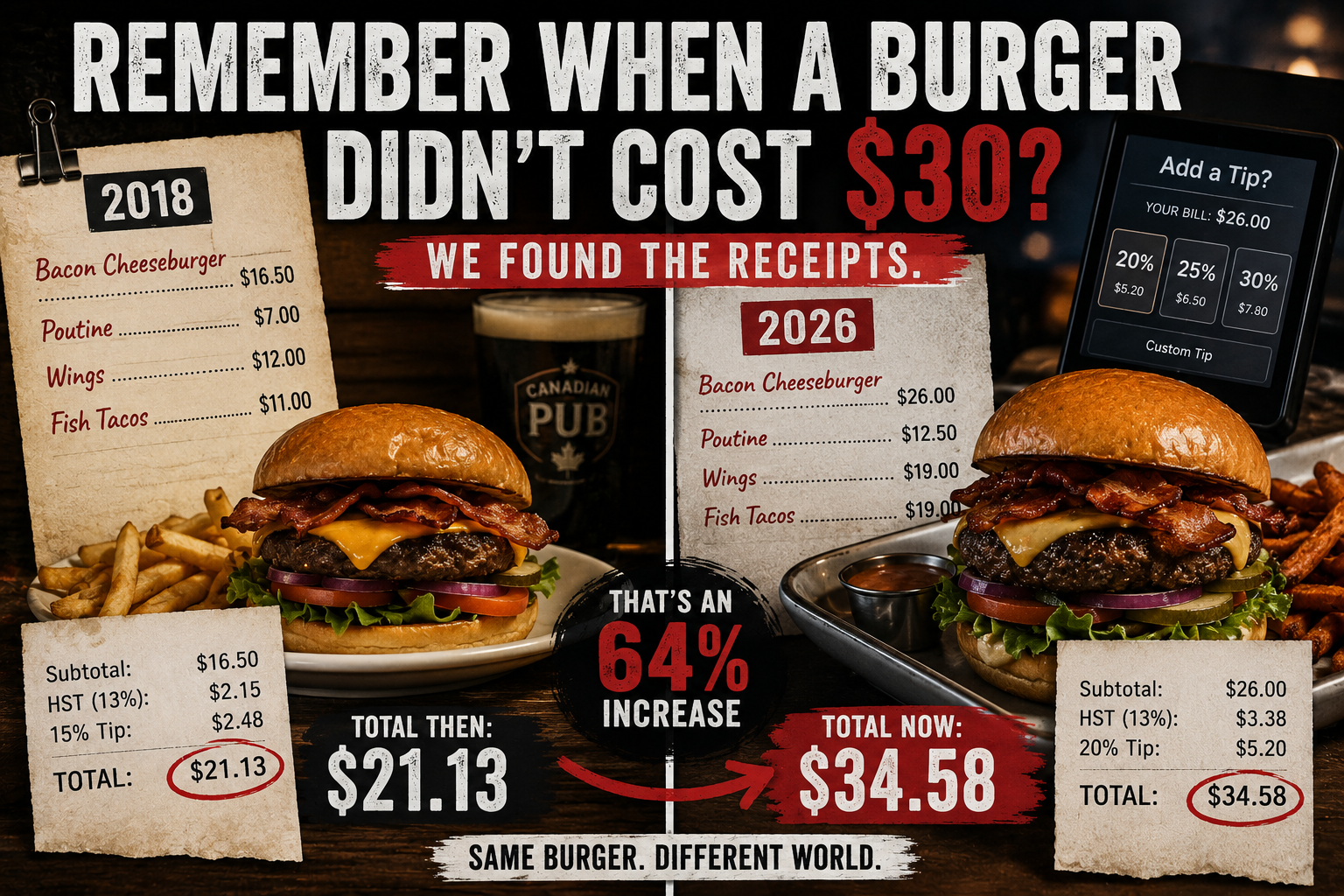
An old Canadian restaurant menu from 2018 has resurfaced online, and the prices look almost ridiculous beside what we’re paying today. It wasn’t 30 years ago. It was eight.
Try to remember what going out for dinner cost in 2018. Not 1985, when we’re told you could apparently buy a house, a Buick and a steak dinner for fourteen dollars. I’m talking about eight years ago.
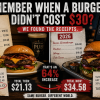
An old Canadian pub menu recently resurfaced online, and putting those prices beside today’s menu is a little startling. Poutine that was $7 is now $12.50. Wings went from $12 to $19. Fish tacos went from $11 to $19. A bacon cheeseburger that cost $16.50 is now $26.
That burger didn’t suddenly come with a lobster tail. It’s still a bacon cheeseburger. The price has increased by about 58 percent. The poutine is up almost 79 percent and the fish tacos are up nearly 73 percent. And, of course, the menu price isn’t what actually comes out of your wallet.
The $26 Burger Isn’t $26
Let’s use Ontario. Order that $26 burger and add 13 percent HST. You’re already at $29.38. Leave a 20 percent tip calculated on the pre-tax price and the burger has now cost you $34.58.
For a burger.
Add a beer or two and you’re somewhere else entirely. Bring your spouse and you’re looking at a casual dinner for two that can sail past $100 without anyone ordering anything particularly extravagant. Bring the kids and what used to be an ordinary family night out becomes something you actually have to budget for.
That’s the part inflation statistics never quite capture. No one sits at the kitchen table celebrating because the annual rate of inflation has moderated. They look at the bill and say, “Seventy bucks for two burgers? Are you kidding me?”
Don’t Blame the Guy Who Owns the Restaurant Yet
Before everybody grabs the pitchforks and heads toward the local pub, there’s something important to understand. Restaurant owners didn’t wake up one morning and collectively decide they’d like to charge thirty bucks for lunch.
I’ve owned restaurants. Trust me, if owners could pack the dining room every Tuesday by selling you a $15 burger and still make money, they’d be doing it.
The problem is that virtually everything underneath that burger costs more. Beef costs more. The bun costs more. Cheese costs more. Cooking oil costs more. Labour costs more. Rent costs more. Hydro, insurance, cleaning supplies, equipment, repairs and merchant fees all have to be paid before the owner gets to keep anything.
Statistics Canada continues to show significant pressure on food costs. Even after the enormous increases Canadians absorbed during the inflation surge, food prices haven’t magically returned to where they started. That’s an important distinction whenever someone tells you inflation has come down. A lower inflation rate means prices are rising more slowly. It doesn’t mean the previous increases disappeared.
If something rises from $10 to $15 and inflation subsequently slows, congratulations. It’s still $15.
The Old Restaurant Math Doesn’t Work Anymore
The restaurant business used to have a wonderfully simple rule of thumb. One third of every dollar went to food, one third went to labour and one third went to the house.
That final third wasn’t profit. The house still had to pay rent, hydro, insurance, advertising, maintenance, equipment, credit card fees, accounting and all the other nickel-and-dime expenses that stop looking like nickels and dimes when you add them together. Whatever survived after all of that was the owner’s profit.
The problem is that formula doesn’t work anymore. Food has pushed against its third. Labour has pushed against its third. Rent has taken a sledgehammer to the final third. Eventually the owner has nowhere left to put those costs except onto the menu.
Then something else happens. You stop going.
That’s where this becomes dangerous for restaurants. They need higher menu prices because their costs have risen, but customers see those prices and eat out less frequently. The restaurant loses volume while its fixed expenses remain. That makes the economics even tighter, which makes it harder to lower prices, which gives customers another reason to stay home.
No one wins.
Go Look on Tuesday Night
People see their favourite restaurant packed on Saturday night and assume the owner must be doing fine. Don’t fool yourself. Go back Tuesday or Wednesday. Better yet, drive past five nights out of seven and actually look through the window.
Birds chirping outside? No problem hearing them.
A lot of dining rooms aren’t merely quieter than they used to be. They’re empty. That packed Saturday night may be the one night keeping the place alive, not evidence that the owner is making a fortune.
The customer isn’t happy paying $26 for the burger. The server isn’t happy staring at an empty section. The cook isn’t getting rich, and I can assure you the restaurant owner looking across 38 empty seats on a Wednesday night isn’t sitting in the office counting piles of money.
Then We Added Tip Fatigue
This is where our recent conversation about tipping collides directly with menu inflation. Canadians aren’t only reacting to higher menu prices. They’re increasingly being asked for higher tip percentages on top of those higher prices.
A 15 percent tip on a $16.50 burger was $2.48. A 20 percent tip on a $26 burger is $5.20. The percentage increased and the number we’re calculating that percentage against increased too. Then the payment terminal turns around and cheerfully suggests 20, 25 or 30 percent.
Of course people are getting irritated.
But eliminating tipping isn’t necessarily the magic solution it appears to be. If a full-service restaurant suddenly has to replace a significant amount of gratuity income through higher wages, that money still has to come from somewhere. Ultimately, a lot of it lands back on the menu. We could eliminate the tip line only to discover that our $26 burger has become a $30 burger.
That’s very different from being prompted for 20 percent after someone pours a coffee into a cup. No one spent an hour looking after my meal or coordinating with a bartender, a busser or the kitchen when I ordered a coffee at a counter. That’s a separate conversation.
We Barely Noticed It Happening
This is what makes an old menu so powerful. It compresses eight years of inflation into about eight seconds.
We didn’t wake up one morning and discover that the $16.50 burger had become $26. It happened gradually. A dollar here, fifty cents there, another menu printing, a supplier increase, a new lease, another increase. Because it happened incrementally, we adjusted to it.
Then somebody puts the two menus beside each other.
2018: $16.50. 2026: $26.
Suddenly you realize how far we’ve travelled.
And this isn’t really about whether someone can technically afford a $26 burger. It’s about what has happened to something that used to be ordinary. Going to the neighbourhood pub wasn’t supposed to require financial planning. It was Tuesday. You didn’t feel like cooking. Someone said, “Screw it, let’s go grab something,” and you went.
That’s what we’re slowly losing. Not fine dining. Not luxury restaurants. Casual dining. The ordinary Canadian night out where you don’t silently calculate the bill before agreeing to leave the house.
Go Find Your Old Menus
So here’s what I want to try. Look in the junk drawer, the cupboard or wherever you’ve kept that pile of takeout menus you somehow never threw away. If you’ve got an old Canadian restaurant menu, send it to us.
Take a picture and tell us the restaurant, the city and approximately what year it’s from. Better yet, if the restaurant still exists, compare the old prices with today’s menu. Maybe your $12 wings became $19. Maybe your $9 breakfast became $17. Maybe that $14 neighbourhood burger really is pushing thirty bucks once everything is added. Or maybe there’s a restaurant near you that’s somehow managed to hold the line. I want to see those too.
Rather than arguing abstractly about whether life has become more expensive, let’s dig out the receipts.
What’s the restaurant meal whose price you simply can’t believe anymore? Tell me in the comments down below. And if you’ve got an old menu, send us a picture.
This could get interesting.
Top popular




Post comments (0)