Listeners:
Top listeners:
-
 play_arrow
The Canadianist Radio Listen. Watch. Read. Discuss. We're in the middle of everything.
-
 play_arrow
Canadianism Podcast | S2 E7 | Quebec Is About to Show Canada What’s Wrong With Our Voting System
SUBSCRIBE NOW TO OUR MAILING LIST

The Canadian Stores We’d Bring Back Tomorrow If We Could
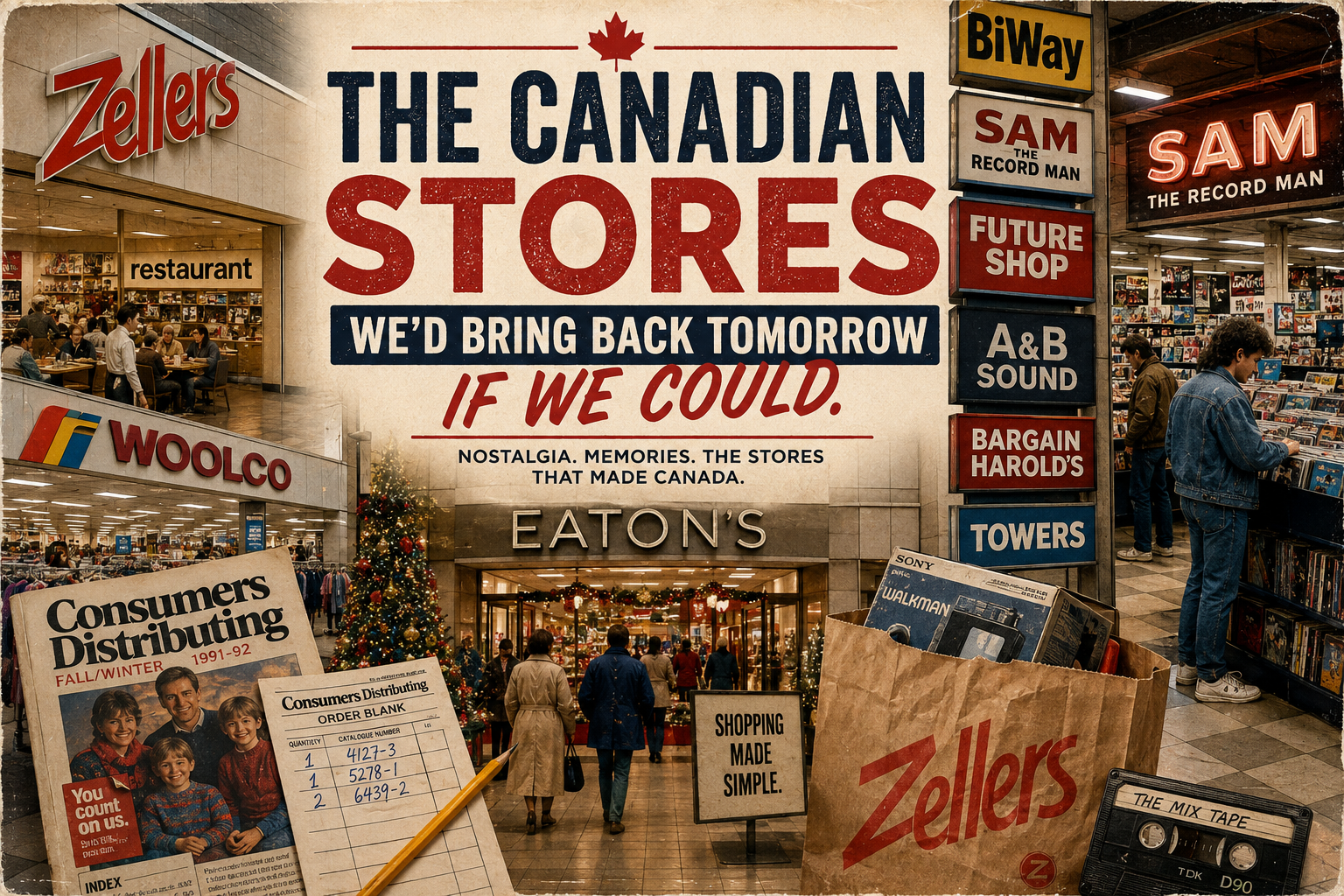
The Canadian Stores We’d Bring Back Tomorrow If We Could
They weren’t necessarily better stores, and nostalgia has a funny way of polishing the floors. But give Canadians one afternoon inside a long-gone retailer and you might be surprised how quickly the memories come back.
There are stores you shop at, and then there are stores that somehow become attached to a period of your life. You remember going there with your mother. You remember what was beside it in the mall. You remember the restaurant upstairs, the catalogue on the kitchen table, the record you bought with money from your first job or the toy you spent six months begging for.
Then one day the store disappears. At first, you don’t think much about it. There’s another retailer in the building, life moves on and eventually you stop noticing that the old sign is gone. Twenty or thirty years later, somebody mentions Consumers Distributing and suddenly you can see the little pencils and order slips sitting on the counter.
So here’s the game. You can bring back one of these stores for one afternoon. Not a modern reboot with an app, self-checkouts and a social-media strategy. I mean exactly as you remember it, including all the things that probably weren’t as wonderful as nostalgia now tells us they were. Where are you going?
Consumers Distributing
Consumers Distributing was online shopping before anyone was online. You didn’t wander around a store looking at merchandise because most of the merchandise wasn’t actually out there to look at. You got a catalogue, found what you wanted, wrote the item number on an order slip and handed it across the counter. Then someone disappeared into the mysterious warehouse in the back.
That was the exciting part. Would they come back carrying your new camera, watch, toaster or Christmas present, or would they return empty-handed and tell you it was out of stock? Anyone who shopped there regularly experienced both outcomes, particularly around Christmas when the catalogue seemed capable of promising considerably more than the warehouse could deliver.
The strange thing is how modern the whole idea sounds today. Browse at home, choose from a catalogue, place an order and have somebody retrieve the item from a warehouse. We essentially rebuilt Consumers Distributing on the internet and made it enormously successful. We just got rid of the pencils and figured out how to tell you whether the damn thing was actually in stock.
Zellers
Zellers wasn’t glamorous, and that’s probably part of why Canadians remember it so fondly. It was simply there. You needed clothes for the kids, towels, a toaster and Christmas lights? Zellers. Your mother announced on Saturday morning that she needed something and you had no idea what it was? Get in the car. We’re going to Zellers.
And then there was the restaurant. That matters, because a proper Zellers resurrection doesn’t count unless the restaurant comes back with it. Shopping and then sitting down for coffee, breakfast or lunch was part of the experience. The restaurant wasn’t some destination dining experience either. It was a restaurant inside Zellers, which was exactly what it was supposed to be.
Most traditional Zellers stores disappeared in the early 2010s, but Canadians never completely stopped talking about them. Maybe what people miss isn’t really Zellers itself. Maybe they miss being the people they were when going to Zellers was simply something you did on Saturday afternoon.
Eaton’s
Eaton’s is different because, for generations, it wasn’t merely another Canadian retailer. It was an institution. The catalogue arrived at the house, families went downtown to shop, Christmas displays became traditions, and you could buy clothing, furniture, appliances, toys and seemingly half the contents of your house from the same company.
If we’re bringing Eaton’s back, I don’t want a little Eaton’s sign slapped onto the corner of a modern department store. Give me Eaton’s as people remember Eaton’s: the downtown store, the elevators, the restaurant, the Christmas decorations and salespeople who actually knew what was in their department. Give me that peculiar old department-store mixture of perfume, clothing and something cooking several floors away.
The company lasted 130 years before going bankrupt in 1999. That’s extraordinary when you think about it. Eaton’s had been part of Canadian life for so long that it seemed permanent, right up until it wasn’t. Plenty of retailers have disappeared since, but very few left a hole quite like Eaton’s.
BiWay
BiWay had a smell. I don’t know exactly what produced it, and I’m reasonably certain there was never a corporate meeting at which executives decided what the official BiWay fragrance should be, but someone reading this knows exactly what I’m talking about. Maybe it was clothes, detergent, vinyl flooring and fluorescent lights heating dust. Whatever it was, I can still imagine it.
BiWay wasn’t selling aspiration. It was selling stuff cheaply, and there was something refreshingly uncomplicated about that. You needed socks, they had cheap socks. You bought the socks and went home. There was no lifestyle branding, membership tier or app asking permission to track your location so it could improve your sock-buying experience.
Canada once had an entire layer of these discount stores. They weren’t trying to make shopping an event. The attraction was that you could afford the stuff, which remains a surprisingly compelling retail strategy.
Sam the Record Man
This one hurts if you love music because buying music used to require leaving the house. You went to the record store intending to buy one thing and then started flipping through albums. Somewhere along the way you found something you hadn’t planned to buy. Maybe you recognized the producer, liked the cover, heard something playing over the store speakers or took a recommendation from somebody behind the counter who knew considerably more about music than you did.
Sam the Record Man became one of the great names in Canadian music retail, and its spinning-record signs on Yonge Street became part of Toronto itself. The flagship eventually closed in 2007, but Sam’s had stores across Canada and generations of Canadians have a record, cassette or CD somewhere in their collection that came home in one of those bags.
Streaming has given us access to more music than Sam could ever have physically stocked, and I wouldn’t trade that away. What streaming hasn’t quite replaced is discovery by accident. An algorithm is very good at finding more things resembling something you already like. A record store could put something in your hands that you didn’t even know you were looking for.
Future Shop
Future Shop disappeared in 2015, which is recent enough that it feels strange to put it in the same article as Eaton’s and Consumers Distributing. For years, though, buying electronics in Canada usually meant at least checking Future Shop. You could go in for a cable and lose half an hour looking at televisions you couldn’t afford.
That was part of the entertainment. You could stand in front of an enormous television, listen to speakers you had absolutely no intention of purchasing, compare computers and ask an employee seventeen questions about something you would eventually decide was fifty dollars cheaper somewhere else.
Buying electronics today is considerably more efficient. Read the specifications, compare prices, click a button and wait for the cardboard box. That’s unquestionably convenient, but no one has ever spent a rainy Saturday afternoon fondly wandering around an online checkout page.
Woolco
For Canadians of a certain age, Walmart didn’t arrive here by building an entirely new retail landscape from scratch. Walmart entered Canada in 1994 by acquiring Woolco stores, and familiar buildings seemed to change identities almost overnight.
That’s one of the strange things about lost retailers. Sometimes the building remains. The parking lot is still there. You may still walk through essentially the same front doors, but it isn’t the same place. The name changes, the signs change and eventually the memories belong to people old enough to remember what was there before.
Woolco was the classic discount department store where a family could arrive needing shampoo and school clothes and somehow leave with a lawn chair. There was nothing particularly glamorous about it, but mention Woolco to the right Canadian and you’ll probably get a story.
A&B Sound
Western Canadians get this one. A&B Sound began in Vancouver and became a destination for music and electronics, particularly in British Columbia. Again, the word destination matters because there was a time when buying music or stereo equipment meant actually going somewhere to do it.
You browsed. You looked at equipment. You talked to somebody who knew far more about speakers than you did. You could spend an afternoon comparing things and eventually carry your purchase home with you. People remember where they bought their first stereo, CD player or favourite album. I’m not sure anyone will be sitting around in 2055 reminiscing about which warehouse shipped their last Bluetooth speaker.
Bargain Harold’s
The name was refreshingly honest. Bargain Harold’s had bargains, and that was pretty much the arrangement. It was part of that once-crowded world of Canadian discount retail where you could buy clothes, household items and whatever else happened to be sitting there at a price low enough to make taking it home seem like a reasonable idea.
Nobody went to Bargain Harold’s for retail theatre. There was no attempt to convince you that purchasing a four-dollar household item represented an expression of your personal identity. Cheap was the attraction, and sometimes that’s all a store needs to be.
Towers
Towers will separate generations immediately. Mention the name to older Canadians and you’ll get instant recognition. Mention it to someone younger and there’s a decent chance you’ll get a blank stare because the chain disappeared in the early 1990s.
That’s exactly why it belongs here. Retail chains can once seem completely ordinary, with stores all over the place and advertising everybody recognizes, and then vanish so thoroughly that the next generation barely knows they existed. For people who remember Towers, though, the name can still summon a surprisingly specific picture of Canadian shopping before today’s big-box landscape took over.
Now, Which One Are You Bringing Back?
We haven’t even scratched the surface. Sears, Simpsons, Woodward’s, Kresge, Woolworth, Dominion, Steinberg’s, A&P, Pascal, Compucentre and RadioShack could all make the argument, and Quebec and Western Canada could probably produce separate lists without breaking a sweat.
That’s why I’m not particularly interested in declaring one of these stores the greatest. I’m interested in which one you’d actually like to walk into again.
Imagine one Canadian store that no longer exists comes back exactly as you remember it. Same merchandise, same signs, same restaurant if it had one, same catalogue, same terrible fluorescent lights and all the other little details you haven’t thought about in years. You get one afternoon inside before it disappears again.
Which store are you bringing back, and what’s the first thing you’re going to look for when you walk through the door? Tell me in the comments down below.

Top popular




Post comments (0)