Listeners:
Top listeners:
-
 play_arrow
The Canadianist Radio Listen. Watch. Read. Discuss. We're in the middle of everything.
-
 play_arrow
Canadianism Podcast | S2 E7 | Quebec Is About to Show Canada What’s Wrong With Our Voting System
SUBSCRIBE NOW TO OUR MAILING LIST

The Canadian TV Guilty Pleasures We’d Never Admit We Loved
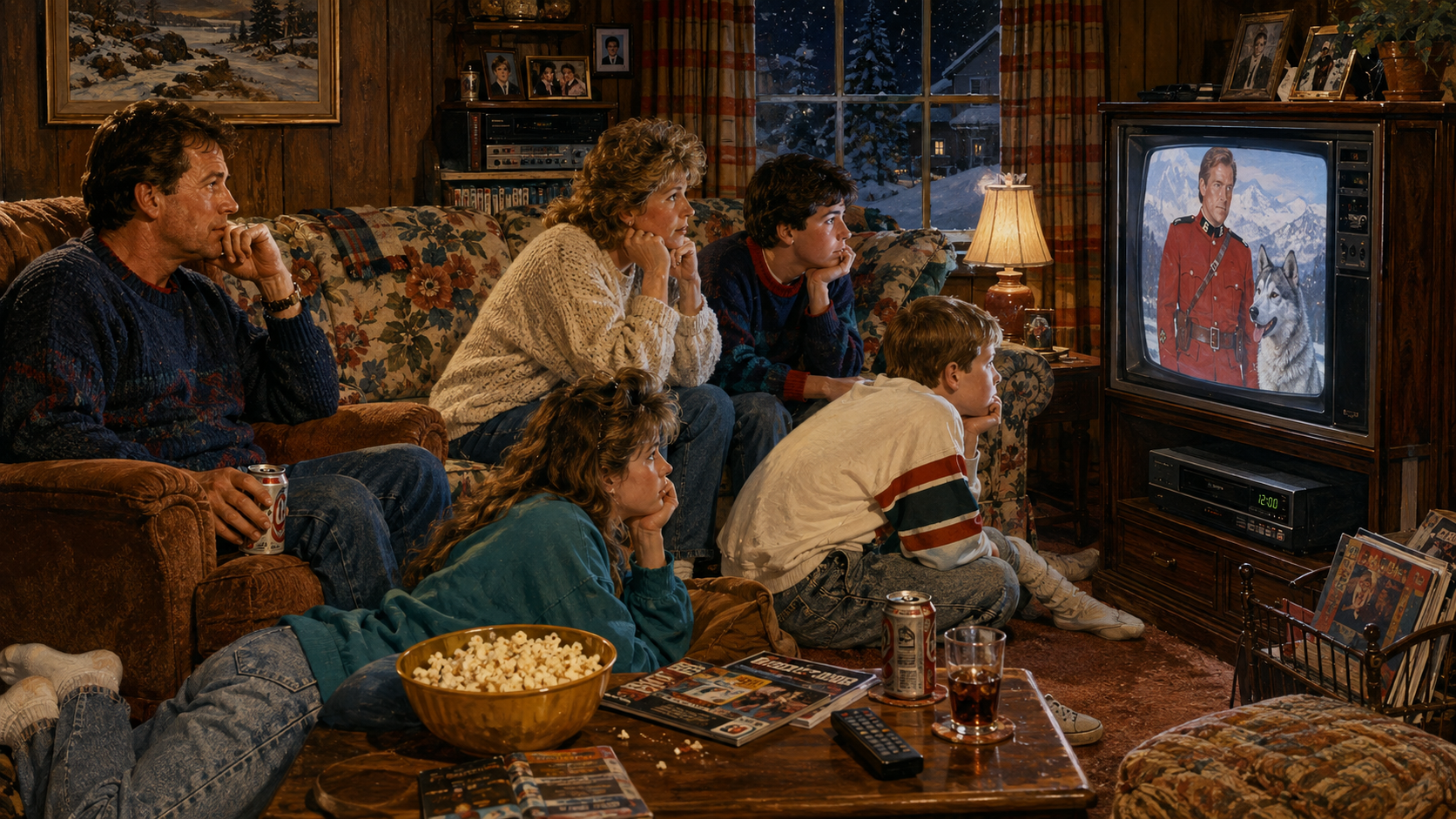
The Canadian TV Guilty Pleasures We’d Never Admit We Loved
They weren’t always prestige television. Some were cheesy, some were weird, and some were so unmistakably Canadian they probably couldn’t have been made anywhere else. But when they came on, we watched.
Canadian television used to be wonderfully strange.
There was a time when you turned on the television and had no idea whether you were about to watch a dog solve a family’s problems, a guy wandering around the British Columbia coast in a beat-up boat, two children attempting to bake something technically classified as food, or a game show built around figuring out words from licence plates.
And we watched all of it.
This isn’t a list of the greatest television Canada ever produced. There’s plenty of genuinely great Canadian television, and we can argue about that another day. These are the guilty pleasures, the shows that occupied some weird little corner of Canadian culture and somehow got permanently lodged in our brains.
Some were actually very good. Some were definitely not. A few become considerably harder to defend when you try explaining the premise to someone who wasn’t there.
But if you grew up watching Canadian television, I guarantee at least one of these is about to unlock something.
The Littlest Hobo
Let’s begin with the obvious one.
Every week, a German shepherd wandered into a new town, discovered some human being whose life had gone completely sideways, figured out the problem, saved the day and then left.
Nobody knew where he was going. Nobody knew where he’d been. Nobody seemed particularly concerned that an extraordinarily intelligent dog was travelling across Canada completely unsupervised.
It didn’t matter.
The formula worked because the Hobo was basically canine Superman. Somebody was in trouble and somehow this dog knew exactly what needed to be done. By the end of the episode, everyone wanted him to stay, but that wasn’t happening. There was always another town, another family and presumably another small child about to fall down a well somewhere.
Then came that theme song.
If you’re Canadian and old enough, I barely need to say anything else. You’ve already got “Maybe Tomorrow” playing in your head.
Just Like Mom
Try explaining this television show to someone in 2026.
Children and their mothers were separated and asked questions to see how well they knew each other. Fair enough. That’s a game show.
Then the children were sent into a kitchen and told to bake cookies.
Without Mom.
This was where Canadian television became art.
The kids had access to perfectly normal baking ingredients, but apparently nobody was stopping them from deciding that what their cookie really needed was an aggressive quantity of ketchup, mustard or some other ingredient that had absolutely no business being anywhere near a cookie sheet.
Then Mom came back and had to figure out which culinary crime had been committed by her own child.
Which meant eating them.
People got paid to develop this format. Other people approved it. A television network put it on the air.
And Canadian children watched it for years.
Fantastic.
The Beachcombers
The Beachcombers was not actually bad television, so calling it a guilty pleasure may be unfair. It was also one of the longest-running dramatic series in Canadian television history.
But it was wonderfully, unmistakably Canadian.
Nick Adonidas operated a salvage business on the British Columbia coast, travelling around in the Persephone collecting logs and getting involved in whatever was happening around Gibsons.
That’s the premise.
A guy retrieves logs.
CBC managed to turn that into nearly two decades of television.
And it worked.
There was something comfortable about The Beachcombers. The scenery was beautiful, the characters became familiar, and Molly’s Reach felt like the kind of place you could actually walk into and order lunch.
For a generation of Canadians, Sunday night television simply looked like British Columbia.
Danger Bay
Now we’re into serious CBC territory.
Danger Bay had everything Canadian television needed in the 1980s: Vancouver, wildlife, environmental stories, family drama and Donnelly Rhodes.
Dr. Grant Roberts was a veterinarian working at the Vancouver Aquarium, which meant there was always some animal requiring assistance while one of his children simultaneously got mixed up in something.
It was wholesome without being completely ridiculous, educational without feeling like homework, and Canadian enough that you could practically smell the rain coming off the television.
There was also something enormously comforting about it. You weren’t watching Danger Bay because you needed to know what happened next in a complex serialized drama. You watched because Danger Bay was on.
Sometimes that was enough.
Definition
Here’s where we find out how old everybody is.
Definition was a Canadian game show built around contestants guessing words from clues. That’s already about as inexpensive a television format as you can imagine, but the real cultural contribution was its theme music.
That theme eventually became considerably more famous as “The Hockey Theme,” the music generations of Canadians associated with Hockey Night in Canada.
But Definition itself was pure old-school daytime Canadian television. A simple set, a simple game and Jim Perry hosting for years before eventually becoming enormously familiar to American audiences through shows such as Card Sharks and Sale of the Century.
There was no million-dollar prize. Nobody was being dropped onto an island. Nobody needed to eat an insect.
People guessed words.
We watched.
Bumper Stumpers
This show was literally about licence plates.
That’s it.
Contestants looked at fictional vanity plates and tried to figure out what they meant.
Somebody walked into a pitch meeting and said, “What if we made a game show about personalized licence plates?” and instead of security escorting them from the building, somebody said, “How many episodes?”
More than 900, as it turned out.
And you know what?
It was fun.
That’s what makes Bumper Stumpers such a perfect Canadian television guilty pleasure. The stakes were almost nonexistent, the concept was wonderfully simple and if you happened across it while channel surfing, suddenly you were trying to solve the licence plate too.
You didn’t choose Bumper Stumpers.
Bumper Stumpers happened to you.
The Raccoons
There is no guilt attached to this one.
The Raccoons was legitimately terrific children’s television, but it belongs here because Canadians of a certain generation have a surprisingly intense emotional attachment to it.
Bert Raccoon, Ralph, Melissa and Cedric lived in the Evergreen Forest while Cyril Sneer, an aardvark with the disposition of an angry industrialist, repeatedly threatened whatever peace and tranquility everyone else was trying to enjoy.
Looking back, the environmental themes weren’t exactly subtle.
Neither was Cyril’s nose.
But the show had personality, warmth and one of those endings that made you slightly sad the episode was over.
Then “Run With Us” played over the credits.
There’s another song currently playing inside thousands of Canadian heads.
You’re welcome.
Seeing Things
Canadian television used to be able to make a show about a balding, middle-aged newspaper reporter who occasionally had psychic visions and somehow turn it into a hit.
Louis Ciccone wasn’t a glamorous television detective. He looked like somebody you’d actually encounter in a Canadian newsroom, which was part of the charm.
The premise allowed Seeing Things to bounce between mystery and comedy without taking itself terribly seriously. Louis would have a vision connected to a crime and then spend the episode trying to figure out what the hell he’d seen.
It was quirky, low-key and completely comfortable being itself.
In other words, very Canadian television.
Street Legal
Now we’re entering guilty pleasure in a slightly different way.
Street Legal was a legitimate drama, but it also gave Canadian television some proper prime-time soapiness. Lawyers, relationships, affairs, ambition, courtroom battles and Cynthia Dale looking considerably more glamorous than anyone I’d ever encountered at an actual Canadian law office.
It ran for years because people cared about the characters as much as the cases.
You could tell yourself you were watching a sophisticated Canadian legal drama.
Sure you were.
You wanted to know who was sleeping with whom.
It’s okay.
We’re all friends here.
The Red Green Show
There was nothing guilty about loving The Red Green Show either, except perhaps recognizing slightly too much of somebody you knew in the characters.
Possum Lodge gave Canada Red Green, Harold, duct tape, the Handyman Corner and an entire philosophy of male incompetence delivered with complete confidence.
The brilliance of Red Green was that the joke wasn’t simply rural Canadians. The joke was a particular kind of man who believed there was absolutely no problem on Earth that couldn’t be solved with whatever was lying around the garage.
Usually badly.
“If the women don’t find you handsome, they should at least find you handy” became one of those lines that escaped the television show and entered Canadian culture.
There are probably sheds across this country still being held together according to Red Green engineering principles.
Royal Canadian Air Farce
For years, Air Farce was where Canadian politicians went to discover which personal characteristic the rest of the country was going to associate with them forever.
Canadian politics is particularly well suited to sketch comedy because our politicians are famous enough for Canadians to recognize but usually not so culturally enormous that comedians become afraid to make them look ridiculous.
The show wasn’t subtle. It didn’t need to be.
And then there was the Chicken Cannon.
Again, imagine pitching this today. We’ll take photographs of people in the news and fire rubber chickens and other disgusting objects at them.
Perfect.
Put it on CBC.
Due South
Due South probably deserves to escape the guilty-pleasure label because it was clever, charming and internationally successful.
But the premise remains gloriously Canadian.
A painfully polite RCMP constable named Benton Fraser goes to Chicago, where his immaculate red serge, impossible decency and Canadian habits make him appear to have arrived from another planet.
He also has a deaf wolf.
Naturally.
The show understood that Canadian stereotypes could be funny without treating Canada itself as the joke. Fraser’s politeness wasn’t weakness. Quite often, the supposedly naive Canadian Mountie was the smartest person in the room.
And Paul Gross became one of those actors an entire generation of Canadians instantly recognizes.
Video Hits
Before YouTube, before Spotify and before music videos became something you deliberately searched for, there was a wonderful concept called turning on the television and hoping they played something you liked.
CBC’s Video Hits was part of that world.
You watched because music videos were still an event. If your favourite song came on, you didn’t skip it. You yelled to someone in another room that it was on.
And if you were really prepared, there might already be a VHS tape sitting in the VCR.
Recording songs off television and radio was basically early streaming with considerably more administrative work.
Fashion Television
Jeanne Beker walking backstage at fashion shows somehow made Canadians interested in an industry happening thousands of kilometres away.
Fashion Television didn’t feel like conventional Canadian television. It travelled. It had access. It looked sophisticated and international at a time when a lot of Canadian programming still looked unmistakably like it had been made inside a CBC studio.
You didn’t even have to care particularly much about fashion to watch it.
Somehow, if Jeanne Beker was standing backstage in Paris talking to somebody wearing something completely insane, you stayed for a few minutes.
Then twenty minutes had passed.
And We Haven’t Even Gotten to Yours
That’s the problem with making a list like this. The minute you start remembering old Canadian television, another show comes wandering out of some forgotten corner of your brain.
Thrill of a Lifetime. The Edison Twins. The Hilarious House of Frightenstein. Today’s Special. Mr. Dressup. The Friendly Giant. North of 60. Kids in the Hall. SCTV. King of Kensington. Degrassi. Night Heat. The Trouble with Tracy. Hockey Night in Canada. And depending on where and when you grew up, there are probably regional shows the rest of the country never saw.
But this isn’t really about which show was best. It’s about the ones you watched even though you might not have admitted it when somebody at school asked what you did last night.
So let’s hear it.
What’s your Canadian television guilty pleasure? The show you watched every week, the show whose theme you can still sing, or the one you’d be genuinely excited to discover was airing tonight? Tell me in the comments down below.
And don’t pretend you were watching documentaries the whole time.

Top popular





Post comments (0)