Listeners:
Top listeners:
-
 play_arrow
The Canadianist Radio Listen. Watch. Read. Discuss. We're in the middle of everything.
-
 play_arrow
Canadianism Podcast | S2 E7 | Quebec Is About to Show Canada What’s Wrong With Our Voting System
SUBSCRIBE NOW TO OUR MAILING LIST

10 Things Canadians Used to Have in Their Homes That Have Basically Disappeared
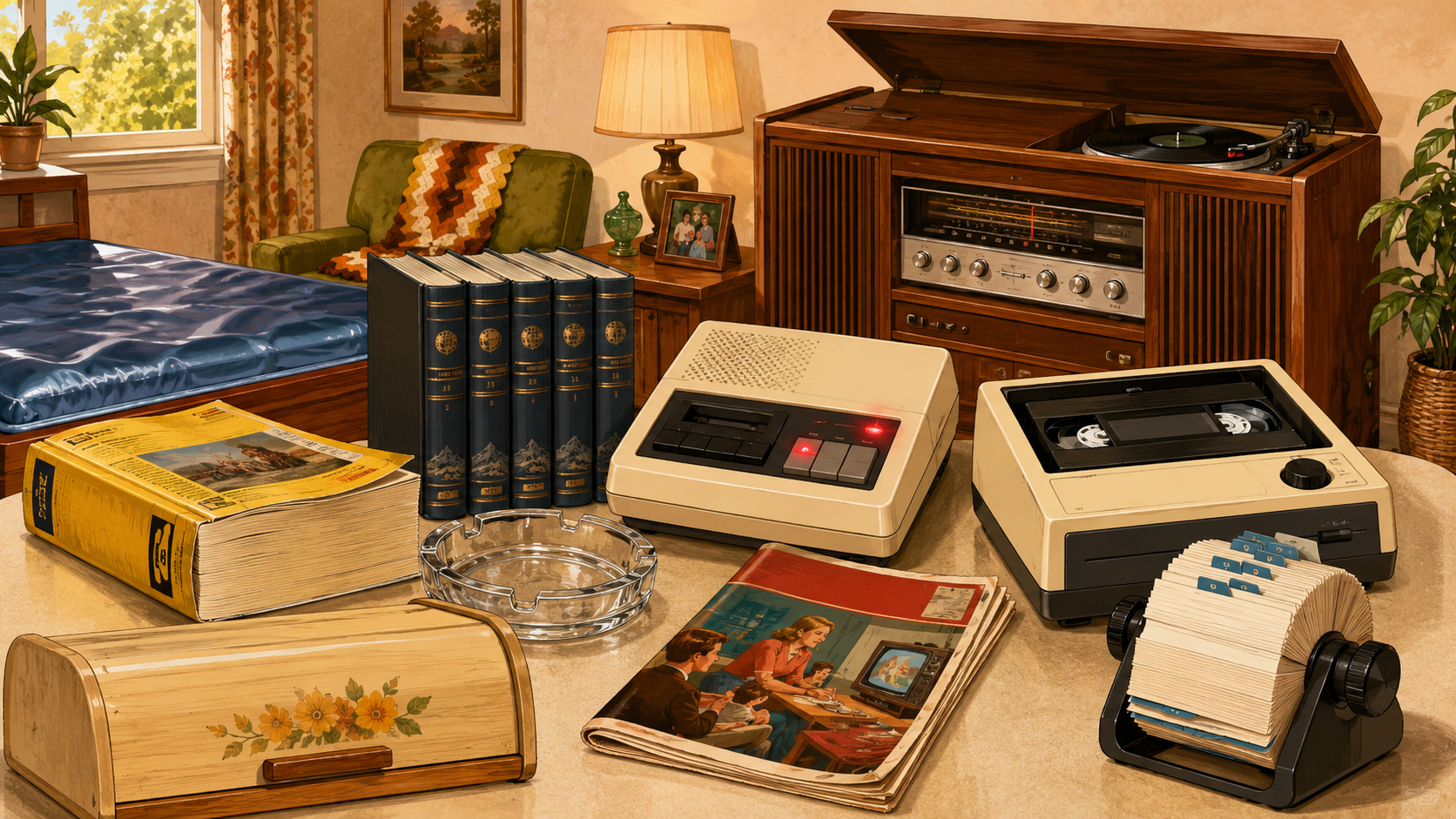
10 Things Canadians Used to Have in Their Homes That Have Basically Disappeared
Once upon a time, every house seemed to have the same strange collection of objects. Nobody announced their disappearance. One day, they were just gone.
There was a time when you could walk into almost any Canadian home and immediately recognize the inventory.
A phone book sat near the telephone. An ashtray was somewhere in the living room whether anyone smoked or not. The TV Guide was folded open to Friday night. A giant stereo cabinet occupied enough floor space to qualify as furniture. None of this seemed unusual because everyone had some version of it.
Most of these things didn’t disappear because somebody decided they were obsolete. Technology changed, habits changed, houses changed, and they quietly slipped out the door.
Here are ten things that used to be everywhere.
1. The Phone Book
The phone book was Google before Google, except it weighed six pounds and occasionally doubled as a booster seat.
Every year, a new one appeared at the door whether you wanted it or not. The white pages contained seemingly everyone in town. The yellow pages contained every business, plumber, pizza place and lawyer willing to buy an ad the size of a postage stamp.
You could find almost anyone, provided you knew roughly how to spell their last name.
Today, receiving a giant directory containing thousands of people’s home phone numbers and addresses would seem slightly insane.
At the time, it was simply Tuesday.
2. Ashtrays
Ashtrays were everywhere.
Restaurants had them. Cars had them. Hotels had them. Living rooms had them. Even households where nobody regularly smoked often had one tucked away somewhere, usually a decorative glass thing that weighed approximately as much as a curling stone.
Smoking indoors was so normal that ashtrays were effectively standard household equipment.
As smoking rates declined and indoor smoking became socially unacceptable, the ashtray vanished remarkably quickly.
There are probably millions of them sitting in basements right now, waiting for archaeologists.
3. Encyclopedias
A full encyclopedia set was once a serious household investment.
Britannica. World Book. Funk & Wagnalls.
Owning a set meant you had knowledge in the house. Children used them for school projects. Adults settled arguments with them. Parents occasionally bought them because a very persuasive salesperson convinced them their children’s future depended on owning Volume Q.
Finding information required commitment.
You had to locate the correct volume, flip through hundreds of pages, find the subject and actually read something.
Then the internet arrived and twenty-four volumes of human knowledge became one search box.
4. The Answering Machine
There was a brief period when the answering machine represented cutting-edge personal technology.
You came home, saw the blinking red light and pressed play.
Maybe someone called.
Maybe nobody called.
Maybe your mother left a four-minute message explaining that she had nothing important to tell you.
Some families recorded elaborate outgoing greetings. Others used the standard robotic voice. Teenagers occasionally changed the message and caused minor household scandals.
Voicemail eventually absorbed the answering machine completely, although it somehow preserved the least enjoyable part: listening to messages.
5. TV Guide
Television used to require planning.
You didn’t simply open an app and choose something. You had to know what was on, what time it started and what channel carried it.
TV Guide was the map.
The little magazine sat on coffee tables across the country, filled with tiny grids of programming information and cryptic abbreviations.
Miss the beginning of a movie? Too bad.
Miss the entire episode? Maybe you’d catch it in reruns six months later.
Streaming has given us almost infinite choice, which has somehow resulted in spending twenty minutes scrolling before deciding there’s nothing to watch.
Progress.
6. The Waterbed
Waterbeds occupied one of the strangest chapters in furniture history.
For a while, apparently normal adults willingly filled a giant vinyl bladder with hundreds of litres of water and then slept on it every night.
They were warm. They moved. They required heaters. They could leak.
Moving one involved equipment and emotional preparation.
Waterbeds were once marketed as futuristic luxury. Then, almost as quickly as they arrived, they disappeared.
Somewhere there is still a man explaining that his back has never been the same since he got rid of his.
7. The VCR Rewinder
The VCR was common.
The standalone VHS rewinder was something else entirely.
This was a device whose entire purpose was saving your VCR from the exhausting burden of rewinding a tape.
You inserted the cassette, closed the lid and listened to it scream backwards at approximately Mach 2.
Some were shaped like cars.
Nobody knows why.
“Be kind, rewind” was once an actual social obligation because returning a movie to the video store without rewinding it was considered an act of minor barbarism.
Now an entire generation has never waited for anything to rewind.
8. The Rolodex
Before every phone number you’ve ever collected lived inside a device in your pocket, there was the Rolodex.
It was basically a circular filing cabinet for people.
Names, phone numbers, addresses and companies were written on little cards and arranged alphabetically.
A well-connected businessperson could have hundreds of them.
Lose your Rolodex and you had essentially lost LinkedIn, your contacts app and half your professional life at the same time.
There was something satisfying about spinning one, though.
Nobody has ever enjoyed scrolling through contacts quite as much.
9. The Bread Box
Bread boxes still exist, but they’re no longer the kitchen fixture they once were.
There was usually one sitting somewhere on the counter, frequently made of metal, wood or a colour best described as 1970s appliance brown.
Its job was simple.
Bread went in the bread box.
Nobody questioned this arrangement.
Modern packaging, larger refrigerators, different kitchens and changing eating habits gradually reduced the need for one.
The phrase survived longer than the object.
“It’s bigger than a bread box” still makes perfect sense to millions of people who haven’t owned a bread box in thirty years.
10. The Giant Wooden Stereo Console
This was not a stereo.
It was architecture.
The classic console stereo was a massive wooden cabinet containing a turntable, radio and speakers, sometimes with storage for records.
It might weigh more than the television.
Some were beautifully made. Others looked like something inherited from a funeral home.
They sat against living-room walls like permanent installations and produced that wonderfully warm sound of records played through oversized speakers built into actual furniture.
Then stereos became smaller.
Then smaller again.
Then music became digital.
Eventually, the enormous wooden command centre of household entertainment was replaced by a speaker the size of a soup can.
That probably says more about the last forty years than any technology textbook ever could.
None of these things disappeared overnight. They simply became less necessary until one day we looked around and realized they weren’t there anymore.
That’s what makes them fun to remember.
The objects themselves weren’t especially remarkable. They were just part of the scenery of ordinary life. Every generation has its own version of them, the things that seem permanent right up until they aren’t.
Forty years from now, somebody will probably write a list called 10 Things Every Home Had in the 2020s.
Number one may very well be a drawer containing seventeen charging cables that fit absolutely nothing.
Top popular





Post comments (0)