Listeners:
Top listeners:
-
 play_arrow
The Canadianist Radio Listen. Watch. Read. Discuss. We're in the middle of everything.
-
 play_arrow
Canadianism Podcast | S2 E7 | Quebec Is About to Show Canada What’s Wrong With Our Voting System
SUBSCRIBE NOW TO OUR MAILING LIST

Dolly Parton, 1946–2026: The Voice, the Wit and the Heart Behind an American Original
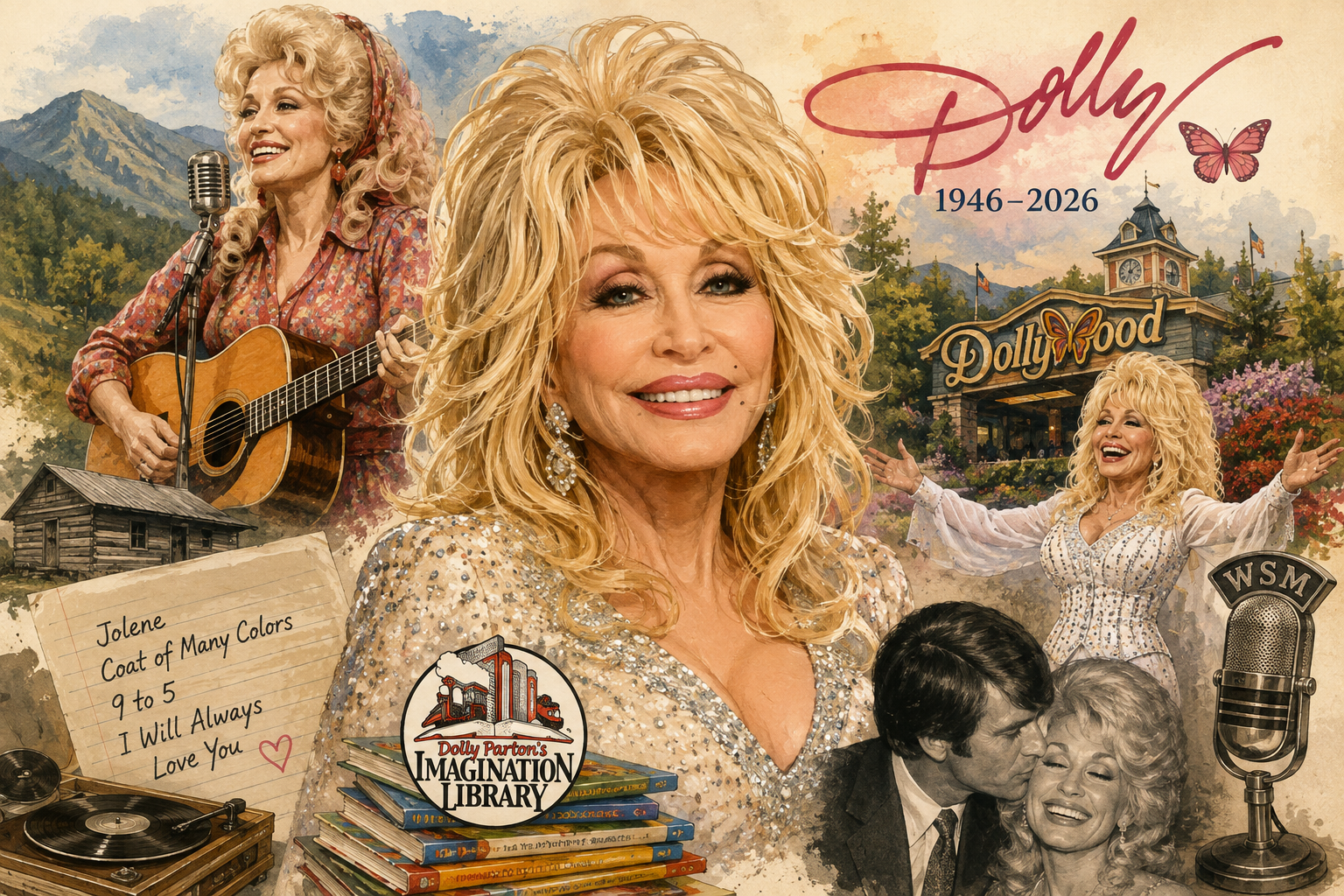
Dolly Parton, 1946–2026: The Voice, the Wit and the Heart Behind an American Original
Dolly Parton, the country music giant whose songs, humour and generosity made her one of the rare entertainers almost everyone seemed to like, has died at 80.
Dolly Parton spent most of her life looking like someone who had arrived from somewhere slightly more colourful than the rest of us.
The hair was enormous. The clothes sparkled. The jokes usually came at her own expense. None of it ever managed to obscure the thing underneath: Dolly Parton was an extraordinary songwriter.
Parton died Tuesday, August 25, in Nashville after a brief battle with cancer. She was 80. Her death was announced by her family, and her representatives said she died surrounded by loved ones at Vanderbilt-Ingram Cancer Center.
She leaves behind one of the most unusual careers in American entertainment, spanning country music, pop, film, television, business and philanthropy without ever quite surrendering the identity of the girl who grew up poor in the mountains of East Tennessee.
Born Dolly Rebecca Parton on January 19, 1946, she was one of 12 children raised in a small home in Sevier County. Music was part of family and church life from the beginning, and she was performing publicly while still a child. Nashville followed soon after high school.
Her national breakthrough came through The Porter Wagoner Show in the late 1960s, but Parton quickly demonstrated that she was never going to remain anyone’s supporting act.
The songs made that clear.
“Jolene.” “Coat of Many Colors.” “9 to 5.” “I Will Always Love You.”
They were direct, melodic and deceptively simple. Parton could write about poverty without romanticizing it, heartbreak without drowning in it and ordinary people without making them sound ordinary.
“I Will Always Love You,” written as a farewell to Porter Wagoner when Parton left his television show and professional partnership, became a country hit for Parton before Whitney Houston transformed it into one of the biggest pop recordings of all time.
Parton owned the song.
That decision alone became part of music-business folklore.
Elvis Presley had wanted to record it, but his manager, Colonel Tom Parker, reportedly required a share of the publishing rights as part of the deal. Parton refused. Years later, Houston’s version generated a fortune in royalties.
It was the sort of story that complicated the cartoon some people occasionally made of Dolly Parton.
She cultivated the blonde wigs and outrageous costumes deliberately. She joked about plastic surgery before anyone else could. She played with the image of the country blonde while quietly remaining one of the shrewdest businesspeople in Nashville.
The joke was frequently on anyone who underestimated her.
Her appeal eventually moved well beyond country music.
Parton starred alongside Jane Fonda and Lily Tomlin in the 1980 comedy 9 to 5, turning the title song into another enormous hit. Roles in The Best Little Whorehouse in Texas, Steel Magnolias and other films followed.
Dollywood, the Tennessee theme park carrying her name, became both a major tourist attraction and a significant employer in the region where she grew up.
Then there was the work that had almost nothing to do with show business.
Parton’s Imagination Library began in 1995 by providing free books to young children in her home county. It eventually expanded internationally and has distributed hundreds of millions of books to children. Her philanthropy also included disaster relief, education and medical research, including a $1 million contribution that helped support research connected to the Moderna COVID-19 vaccine.
Her husband, Carl Dean, whom she married in 1966, remained almost entirely outside public life. Their marriage lasted nearly six decades until his death in 2025.
Parton somehow managed something even more difficult than longevity in show business.
She remained broadly liked.
Her career stretched through enormous changes in American culture without requiring her to become a permanent participant in every political argument. She had opinions, certainly, but she seemed to understand that not every microphone needed to become a battlefield.
That helped make her something increasingly rare: a genuine cross-generational celebrity.
Country fans claimed her. Pop fans claimed her. Rock musicians claimed her. Broadway audiences knew her. Children received books because of her. People who couldn’t name five country singers still knew Dolly.
She was inducted into the Country Music Hall of Fame in 1999 and the Rock & Roll Hall of Fame in 2022, initially protesting that she didn’t believe she had earned the latter because she considered herself a country artist. She eventually accepted and responded in the most Dolly Parton way possible by recording a rock album.
The numbers are enormous. The awards are enormous. The record sales are enormous.
They aren’t really the reason people will miss her.
Dolly Parton possessed that increasingly uncommon ability to be unmistakably famous without seeming entirely removed from ordinary people. She understood hardship because she had lived it. She understood ambition because she had plenty of it. She understood the value of constructing a persona without allowing the persona to consume the person.
The wigs were part of the show.
The songwriter was real.
So was the generosity.
So was the intelligence.
Dolly Parton spent seven decades making sure we noticed the sparkle.
She left behind considerably more than that.

Top popular






Post comments (0)