Listeners:
Top listeners:
-
 play_arrow
The Canadianist Radio Listen. Watch. Read. Discuss. We're in the middle of everything.
-
 play_arrow
Canadianism Podcast | S2 E7 | Quebec Is About to Show Canada What’s Wrong With Our Voting System
SUBSCRIBE NOW TO OUR MAILING LIST

10 Canadian Songs Everyone Here Knows, But Americans Probably Don’t
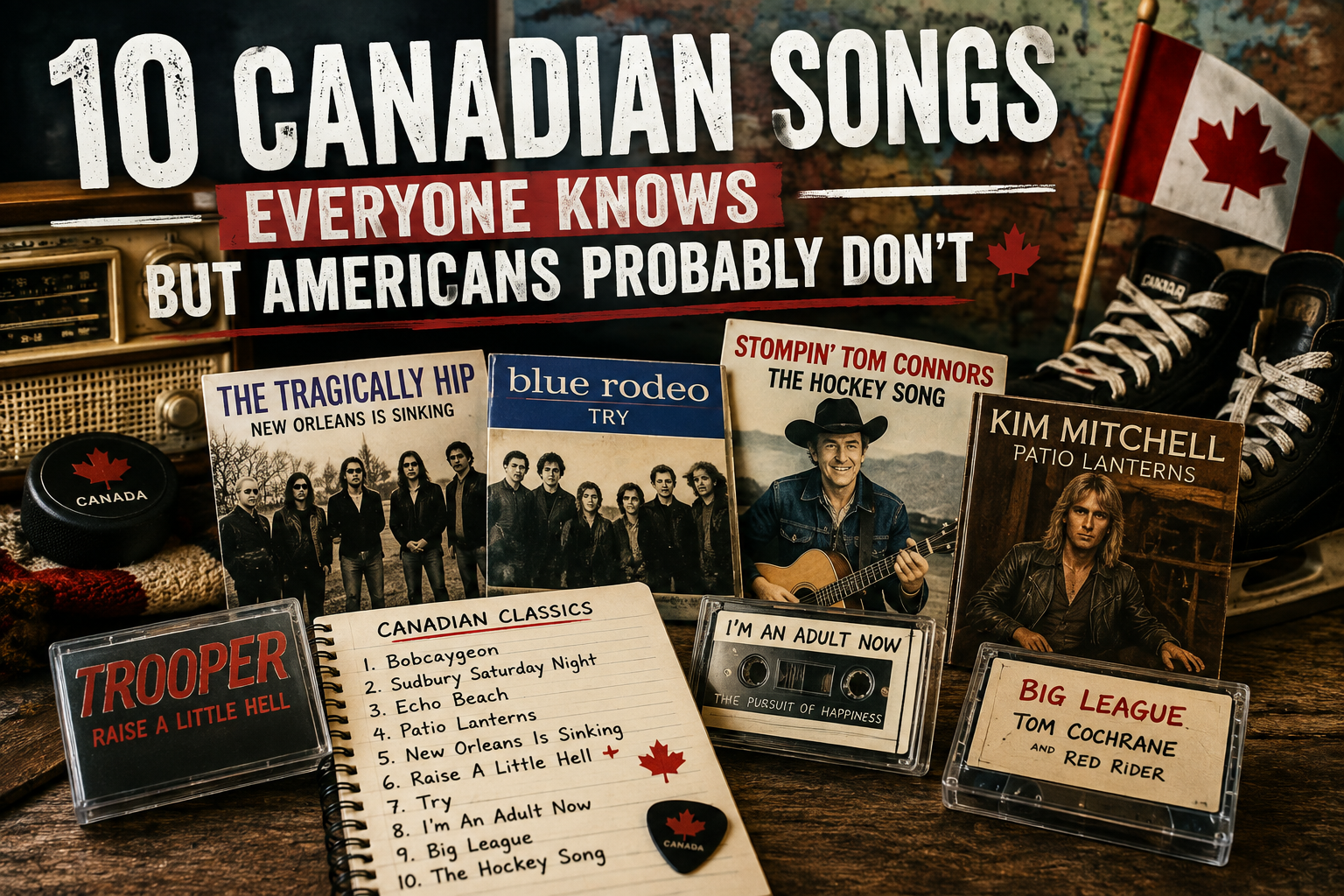
10 Canadian Songs Everyone Here Knows, But Americans Probably Don’t
There was once an entire layer of Canadian music that could be enormous north of the border and practically invisible a few hours south. If you grew up here, some of these songs weren’t simply hits. They were part of the wallpaper.
There’s a funny thing that happens when Canadians talk about music with Americans.
You mention a song you assume everybody knows.
Blank stare.
You try the artist.
Nothing.
Then you begin humming it, which rarely improves the situation.
Canada has produced plenty of genuine international superstars. Joni Mitchell, Neil Young, Bryan Adams, Céline Dion, Shania Twain, Alanis Morissette, Drake, The Weeknd and Justin Bieber certainly don’t require us to explain to Americans who they are.
But underneath all of that international success exists another Canadian musical universe.
These are records that played constantly on Canadian radio, turned up at school dances, blasted out of cars, appeared at hockey games and became part of the soundtrack of growing up here. Some crossed the border a little. Some developed pockets of American recognition. A few became successful elsewhere in the world.
But they never became part of American culture in quite the way they became part of ours.
If you’re Canadian, see how far down this list you get before finding one you don’t know.
10. “Echo Beach” — Martha and the Muffins
This one is particularly strange because “Echo Beach” wasn’t merely a Canadian success.
It became a Top 10 hit in Britain in 1980.
America largely missed the party.
For Canadians of a certain age, though, that opening immediately transports you somewhere. Martha and the Muffins came out of Toronto’s late-1970s new-wave scene and produced a song that still sounds wonderfully unlike most of the Canadian rock surrounding it at the time.
There’s another wonderfully Canadian twist to the story. Toronto eventually got an actual concert venue called Echo Beach.
The song came first.
That’s a pretty good indication that you’ve entered the cultural furniture.
9. “Raise a Little Hell” — Trooper
Put this on at the right Canadian gathering and see how long it takes before someone starts singing along.
Trooper is one of those bands that exposes the difference between Canadian musical memory and American musical memory.
Here, they’re part of classic rock.
“Raise a Little Hell” has survived decades of changing formats and tastes because it has exactly what a durable rock song needs: a riff you recognize immediately, a chorus built for a room full of people and absolutely no interest in being subtle.
South of the border, the reaction can be very different.
Trooper who?
Canada knows.
8. “I’m an Adult Now” — The Pursuit of Happiness
This may be the most late-1980s Canadian entry on the list.
Moe Berg and The Pursuit of Happiness emerged from Toronto and gave Canadian radio one of those songs that was funny, irritated and ridiculously catchy at the same time.
It captured that peculiar moment when you’re technically an adult but beginning to discover that adulthood wasn’t quite the arrangement you were promised.
The song became closely associated with the band’s breakthrough in Canada and remains instantly familiar to plenty of Canadians who were listening to rock radio in the late 1980s and early 1990s.
Ask an American of the same age?
Your results may vary considerably.
7. “Patio Lanterns” — Kim Mitchell
This may be the ultimate test.
Say “Patio Lanterns” to a Canadian Gen Xer and there’s a very good chance something immediately lights up in their brain.
Summer.
Backyards.
Teenagers.
Cheap outdoor furniture.
That slightly awkward period when everyone was trying to figure everyone else out.
Kim Mitchell did have some American exposure. “Go for Soda” even reached the U.S. Hot 100, and “Patio Lanterns” received some American rock-radio play.
But America never adopted Kim Mitchell the way Canada did.
Here, “Patio Lanterns” became one of those songs that doesn’t seem to belong to a particular year anymore.
It just belongs to summer.
6. “Try” — Blue Rodeo
This is where the experiment gets interesting.
Put “Try” on in a Canadian room containing people old enough to remember the late 1980s and watch what happens.
Then try the same experiment in Ohio.
Blue Rodeo’s career in Canada has been enormous. They’re one of those bands whose catalogue accumulated gradually until the songs became part of the country itself.
“Try” was there near the beginning.
It’s a beautiful record without needing to announce that it’s beautiful. Jim Cuddy’s voice, Greg Keelor’s presence and that unmistakable Blue Rodeo mixture of country, rock and melancholy created something Canadian radio never really stopped loving.
America never developed quite the same relationship with them.
Their loss.
5. “Big League” — Tom Cochrane and Red Rider
Now we’re getting very Canadian.
Tom Cochrane is an interesting case because Americans absolutely know one of his songs.
“Life Is a Highway” was a genuine American hit, reaching No. 6 on the Billboard Hot 100. Years later, Rascal Flatts introduced it to another generation.
But ask Americans about “Big League.”
That’s different.
In Canada, the song carries considerably more weight. It’s connected to hockey, small-town ambition, parents, kids and the enormous hopes families can place on a young athlete.
You don’t need to be a hockey player to understand it.
But being Canadian probably helps.
4. “Sudbury Saturday Night” — Stompin’ Tom Connors
We could have filled half this list with Stompin’ Tom.
“Bud the Spud.”
“Tillsonburg.”
“The Hockey Song.”
And, of course, “Sudbury Saturday Night.”
Stompin’ Tom did something unusual. He spent his career singing unabashedly about Canada at a time when Canadian performers were often encouraged to make themselves more internationally marketable.
He sang about our towns, our jobs, our roads and our peculiarities.
“Sudbury Saturday Night” consequently doesn’t require an American audience to validate it.
That’s almost the point.
It’s ours.
3. “New Orleans Is Sinking” — The Tragically Hip
The title is American.
The phenomenon definitely wasn’t.
The Tragically Hip may be the greatest example of the strange musical border we’re talking about.
In Canada, they became enormous. Not merely successful. Important.
Their songs contained Canadian places, history, characters and references without stopping every few minutes to wave a flag at you.
When Gord Downie performed his final concert with the band in Kingston in 2016, the CBC broadcast it nationally.
Try explaining the cultural scale of that to someone who only knows the Hip as a Canadian rock band that never quite broke America.
“New Orleans Is Sinking” was one of the records that started the whole thing.
America had plenty of chances to discover the Hip.
We kept them anyway.
2. “The Hockey Song” — Stompin’ Tom Connors
Okay, this one is almost cheating.
Of course Americans who spend enough time around hockey may know it. The song has been played in American NHL arenas as well as Canadian ones.
But knowing “The Hockey Song” and having “The Hockey Song” embedded somewhere in your Canadian brain are two different things.
Released in 1973, it eventually spread through Canadian hockey arenas and became so closely connected with the game that the Canadian Songwriters Hall of Fame inducted it in 2018.
It isn’t sophisticated.
It doesn’t need to be.
Some songs are records.
Some songs become traditions.
“The Hockey Song” crossed that line a long time ago.
1. “Bobcaygeon” — The Tragically Hip
If we have to choose one song that demonstrates this entire Canadian-American musical divide, this may be it.
Say “Bobcaygeon” in Canada and you’re not merely naming a town in Ontario.
You’re naming a Tragically Hip song.
And for an enormous number of Canadians, you don’t need to explain anything beyond that.
The remarkable thing about the Hip was that they never seemed particularly desperate to translate Canada for somebody else. Places were allowed to be places. References were allowed to be Canadian. Listeners could catch them or discover them later.
That may help explain the strange divide.
American success is normally treated as the final proof that a Canadian artist has made it.
The Tragically Hip demonstrated that it didn’t necessarily have to be.
They could fill arenas here, become woven into the country’s cultural life and create songs Canadians would carry with them for decades without becoming an equivalent American phenomenon.
“Bobcaygeon” might be the perfect example.
Millions of Canadians don’t need it explained.
A surprising number of Americans probably do.
We Had Our Own Radio Country
There’s a reason this happened.
For decades, Canadian radio operated alongside American radio while still developing its own musical ecosystem. Canadian-content requirements helped give domestic artists airtime, but radio alone doesn’t explain why certain records survived.
People had to actually like them.
And we did.
Some Canadian artists crossed the border and became international stars. Others crossed briefly. Some barely crossed at all.
Yet Canada was large enough to sustain careers, create stars and develop its own musical memory.
That’s why two people born 200 kilometres apart on opposite sides of the border can have completely different reactions when somebody puts on “Patio Lanterns.”
One hears an old song.
The other suddenly remembers being seventeen.
That’s not really about charts anymore.
That’s culture.
And there’s no chance we’ve got the definitive ten.
Where’s April Wine? Max Webster? Chilliwack? Streetheart? Doug and the Slugs? Rough Trade? Platinum Blonde? Glass Tiger? Honeymoon Suite? Great Big Sea? Northern Pikes? 54-40?
Exactly.
What’s the Canadian song you assumed everybody knew until you discovered Americans had barely heard of it?
Tell me in the comments down below. And if we’ve committed some unforgivable Canadian musical offence by leaving one off, let’s hear that too.
There may need to be a Part Two.


Top popular






Post comments (0)