Listeners:
Top listeners:
-
 play_arrow
The Canadianist Radio Listen. Watch. Read. Discuss. We're in the middle of everything.
-
 play_arrow
Canadianism Podcast | S2 E7 | Quebec Is About to Show Canada What’s Wrong With Our Voting System
SUBSCRIBE NOW TO OUR MAILING LIST
Forget Beef. One Grocery Staple Is Up 138% Since 2020
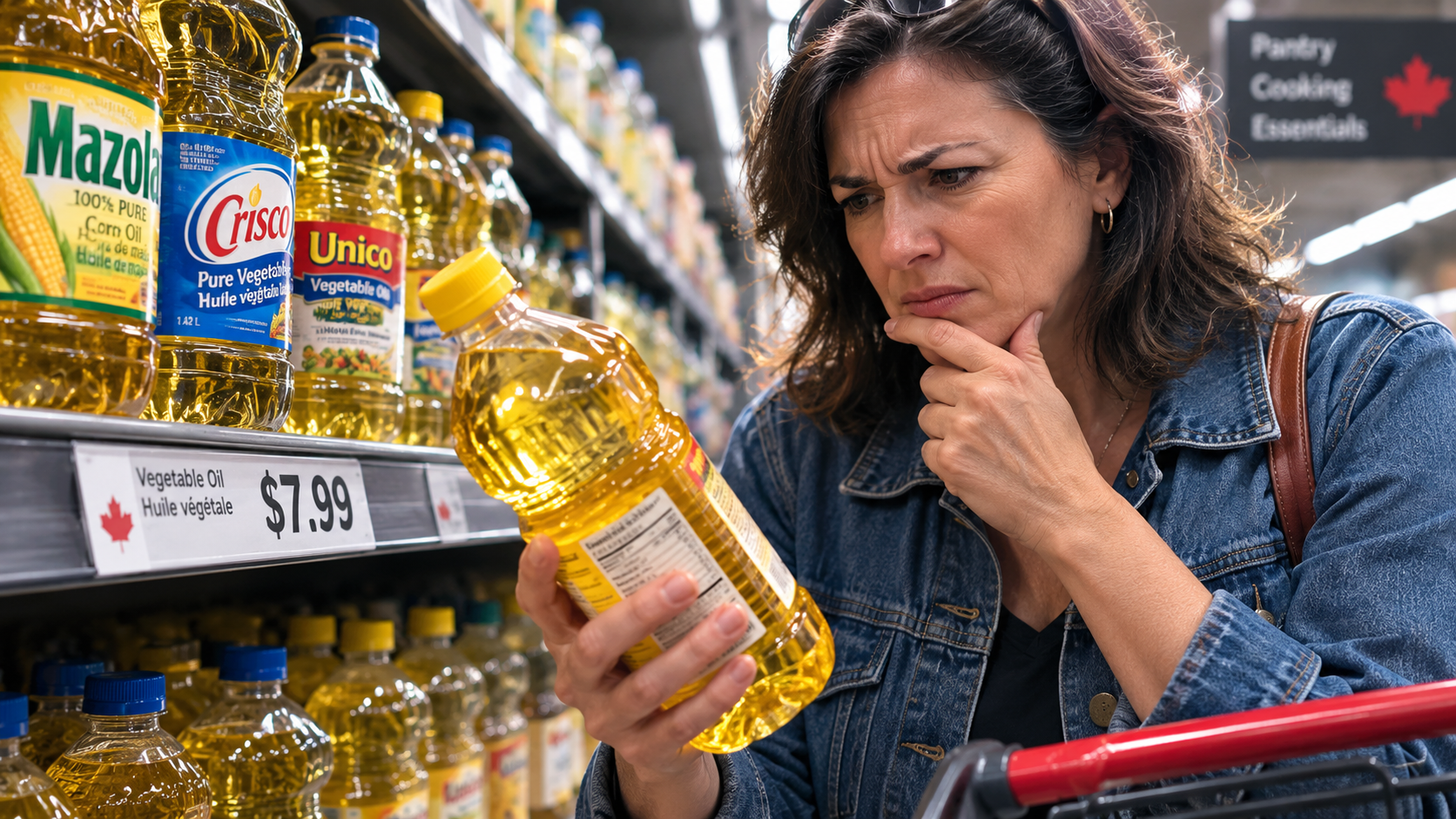
Just when you thought we’d beaten the price of beef to death, along comes vegetable oil.
Yes, vegetable oil.
Not prime rib. Not filet mignon. Not some imported delicacy you’re buying twice a year. The bottle of cooking oil sitting beside the stove.
An analysis of Statistics Canada’s monthly retail-price data found that vegetable oil was up 138 percent between January 2020 and June 2026, more than any other grocery item in the comparison.
Think about that for a second.
Something that cost you $10 at the beginning of 2020 would cost $23.80 after a 138 percent increase.
And this is where the conversation about inflation gets interesting, because Canadians keep hearing that inflation is coming down. That’s true when we’re talking about the rate at which prices are increasing. It doesn’t mean the prices that already went through the roof came back down.
That’s a distinction that gets lost constantly.
If something goes from $10 to $15 and then inflation slows down, congratulations. It’s still $15.
For people standing in a grocery store trying to feed a family, that’s the number that matters.
The Grocery Store Has Become an Economics Lesson
Statistics Canada tracks monthly average retail prices for more than 100 food products across the country, and when you start looking through those numbers, you begin to understand why Canadians don’t necessarily feel the relief that broader inflation statistics suggest they should.
Vegetable oil is an especially interesting example because it isn’t just something consumers buy at the grocery store. It’s an input.
Restaurants use it. Food manufacturers use it. Bakeries use it. Prepared foods use it. It’s part of the cost of producing other things we eat.
So when something like cooking oil shoots up, the impact doesn’t necessarily stop at the price of the bottle.
It can work its way through the food system.
We’ve already talked about beef prices at The Canadianist and why rebuilding Canada’s cattle supply isn’t something that happens overnight. Coffee and cocoa have faced their own pressures. Weather, global commodity markets, transportation, processing capacity and international supply disruptions all eventually find their way onto Canadian shelves.
But there’s another part of the grocery bill that deserves considerably more attention.
Competition.
Ottawa Is Now Looking at the Whole Food Chain
The Competition Bureau launched an examination this summer into competition across Canada’s entire food supply chain.
And I mean the entire thing.
They’re looking at production and processing, including how food is grown, caught, transformed and packaged. They’re looking at transportation and distribution. And they’re looking at what happens when the product finally reaches the grocery store.
That’s where things get particularly interesting.
The Bureau specifically says it’s examining retail pricing practices including loyalty programs, pricing algorithms, shrinkflation and skimpflation.
Shrinkflation most Canadians understand by now. The package gets smaller while the price stays the same or goes up.
Skimpflation is its sneaky cousin. The package might look the same, but something inside changes. Ingredients can become cheaper, quality can decline or the product can otherwise be altered while the customer continues paying the same price.
Then there are pricing algorithms.
That’s the one I’m particularly interested in seeing examined.
We’ve spent years talking about grocery prices primarily as an inflation problem. The Competition Bureau is effectively asking a broader question: where along the journey from the farm to the grocery shelf might a lack of competition also be contributing to what Canadians pay?
That’s an important distinction.
Not every price increase is evidence of gouging. A drought is real. A cattle shortage is real. Transportation costs are real. Commodity prices are real. Wages, energy and processing costs are real.
But competition matters too.
That’s why we shouldn’t reduce this conversation to either “the grocery stores are ripping us off” or “it’s all inflation.”
Food doesn’t magically appear on a supermarket shelf.
There’s a farmer or producer at one end. Then there may be processors, packagers, distributors, trucking companies, warehouses and retailers between that producer and you.
Every one of them has costs. Every one of them has to make enough money to continue operating.
The question is whether enough competition exists at each stage to keep everybody honest.
Remember the Old Restaurant Formula?
I wrote recently about the old restaurant formula I used when I was in the business. One third food, one third labour, one third for the house.
The problem is that formula doesn’t work anymore.
Food is one of the reasons.
When restaurants are paying dramatically more for beef, cooking oil, produce and other ingredients, they have three choices. Raise prices, reduce portions or absorb the cost.
You can only absorb it for so long before there isn’t a restaurant anymore.
And don’t look at the packed dining room on Saturday night and tell yourself the owner is doing fine.
Go back Tuesday.
Or Wednesday.
Birds chirping outside? No problem hearing them.
The pressure at the grocery store and the pressure inside your neighbourhood restaurant aren’t separate stories. They’re different ends of the same food economy.
The Number on the Inflation Report Isn’t Your Grocery Bill
This is probably the biggest disconnect in the entire conversation.
Governments and economists quite correctly measure inflation by looking at changes across a broad basket of goods and services.
Your household doesn’t experience inflation that way.
You experience it one item at a time.
You remember what hamburger used to cost.
You remember what coffee used to cost.
You remember when a bag of groceries didn’t make you look at the receipt twice before leaving the store.
And apparently, we should now add vegetable oil to that list.
A 138 percent increase since 2020 doesn’t mean somebody somewhere necessarily pocketed 138 percent more profit. There are too many moving parts in the food system to make an assumption like that.
But it absolutely warrants asking how we got here.
That’s why the Competition Bureau’s examination could be important. Instead of looking only at the supermarket at the end of the chain, it’s looking from production through processing, transportation, distribution and finally retail pricing.
That’s where we may finally get a better answer to the question Canadians have been asking for years.
Why does feeding ourselves cost so much more than it used to?
And perhaps more importantly, which parts of that increase were unavoidable, and which weren’t?
What are you seeing in your grocery cart? What’s the one item you buy regularly whose price has made you stop and say, “You’ve got to be kidding me”?
Tell me in the comments down below. I want to hear what you’re seeing where you live.
Top popular




Post comments (0)